Ancient Magic and Religion:
roman temples and rituals
Overview
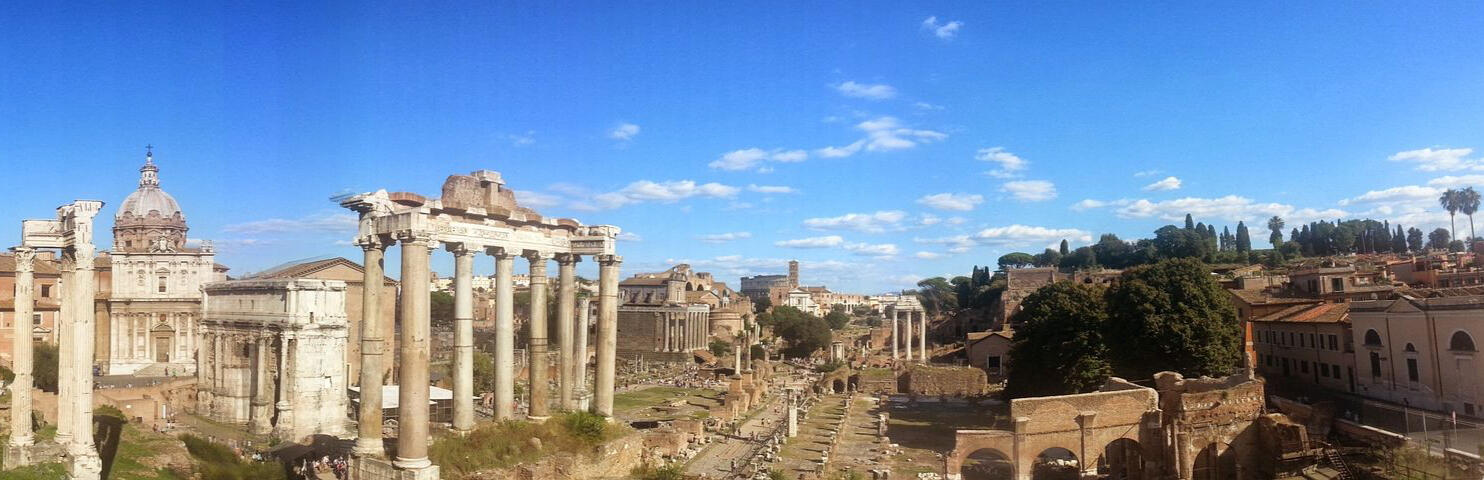
For this project, we were tasked with creating a set of objects that relate to broad concepts regarding ancient magic and religion. We decided to focus on temples and rituals because this is one of the first topics we explored in the class. Building off this familiarity, we sought to expand our understanding of the way individuals interacted with these elements. We researched objects from both Ancient Greece and Rome so that our project would present a broader view of our selected topic. The following pages focus on the Roman Pantheon, various structures located at the sanctuary of Delphi, as well purification rituals, which were an integral part of ancient religion.
The pantheon
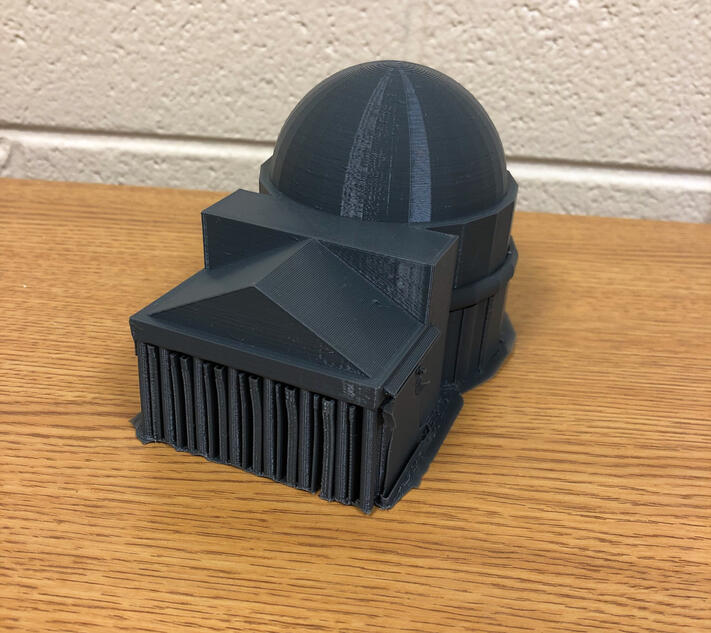
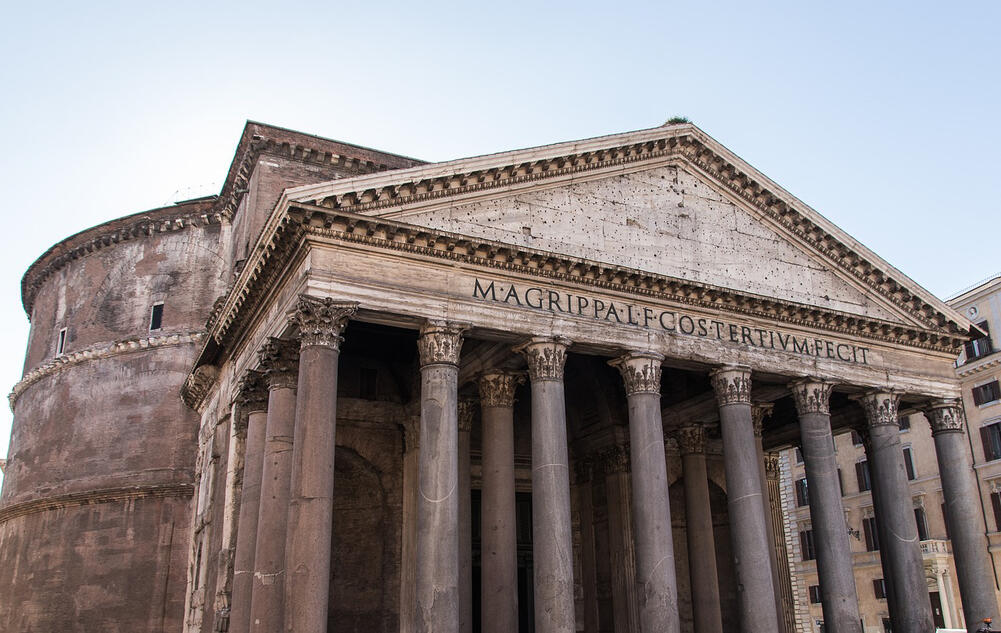
Model of the Pantheon presented beside the actual structure
Depicted above is the Pantheon, one of the most beautiful, pristinely preserved structures from the ancient Roman world. Erected in 125 CE, this temple was built under the reign of Emperor Hadrian, commonly known as one of the best rulers of his time. Despite the fame and attraction the Pantheon gather, very little is known in regard to who built this temple or how long its construction took due to lack of documentation.
The walls of the building were crafted using bricks and concrete (opus caementicium). Roman concrete was especially durable because the mixture was infused with pozzolanic ash. This key ingredient made the concrete extremely durable and allowed it to withstand natural elements for long periods of time. The dome is made entirely out of this concrete and was originally covered in a layer of bronze. This bronze coating was later removed by the emperor Constans II in 663 CE. The stability of the large dome is particularly impressive for an ancient structure. Another defining feature of the Pantheon is the Oculus, which is an opening at the very top of the dome that allows natural sunlight to shine into the building. The overall structure of the Pantheon showcases how advanced the Romans were in the field of engineering.
The purpose of the Pantheon has been widely debated by scholars all over the world. Their discussion has resulted in two general conclusions on what this structure’s purpose might have been. Some believe its primary purpose was to function as a temple for many gods; this is supported by both the size of the building, as well as writings from Pliny the Elder confirming the existence of statues of Venus and Jupiter in the Pantheon. Others believe that it was rather a cult or group dedicated to the worship of a leader; in this theory, the Pantheon would have been both a place to give worship and reverence to a leader as well as a place for the emperor to make appearances to his people. Standing around the grandeur of the temple, it would have been easy for the emperor to remind the audiences of his divine status.
After losing its capital status, Rome and the Pantheon alike fell into shambles. This period of disrepair lasted for more than 130 years, until Pope Boniface IV converted this temple into a Christian church; this action would later be recognized as the first time a pagan temple was consecrated as a Christian church. Though this conversion came as a blow to many, this action was essential in the Temple’s survival, as the papacy was able to provide the funding and support necessary to not only repair but maintain the temple. It is generally agreed upon that this funding and support are likely a few of the main reasons the Pantheon remains the best preserved Roman temple to date.
fun facts!
The Pantheon’s dome was the largest built until modern times
Despite being one of the most well preserved Roman buildings in the world, the building itself was built on the ashes of two pantheons that originally stood in its place. The first caught fire, burning down in 80 CE, while the second was struck by lightning and also burned down in 110 CE.
Some hypothesize that the dome and oculus served as a sundial.
Many famous historical figures are actually entombed within the walls of the Pantheon.
Delphi
The temple of apollo
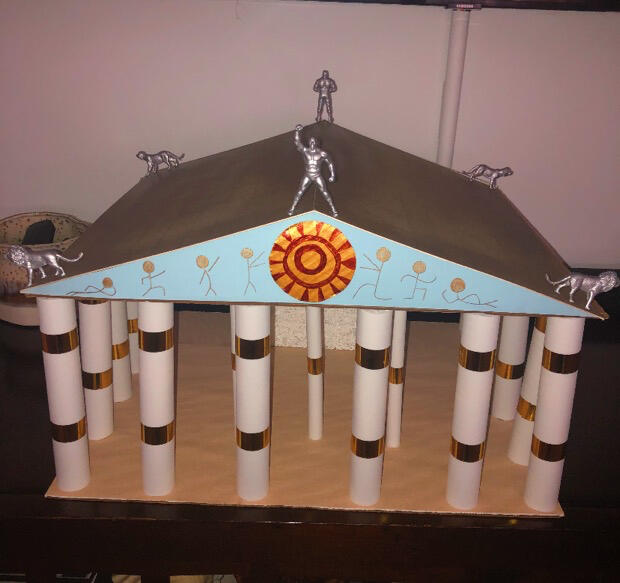
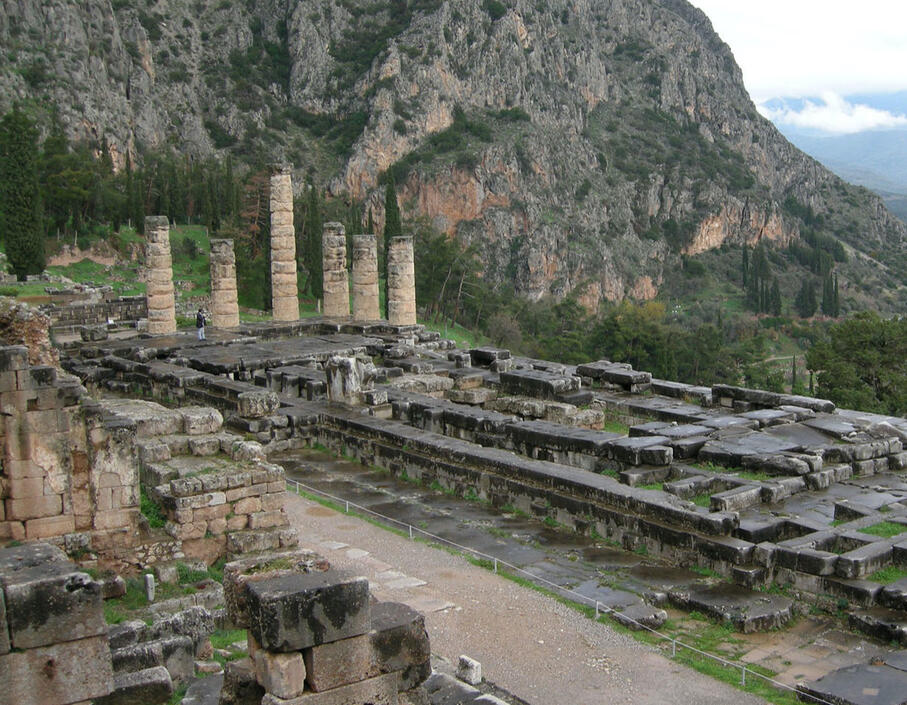
Model of the Temple of Apollo beside the present day site. Since ancient times, the temple has crumbled leaving only a few pillars behind.
This is the Temple of Apollo at Delphi. It was first built in the 8th century BCE but was destroyed by fire in 548 BCE. It was rebuilt but then destroyed by an earthquake in 373 BCE. The third building was constructed in 330 BCE to resemble the second version, and it stands today.
It morphed from a gathering place for 12 Greek tribes into a panhellenic place of worship, primarily for Apollo and the Oracle of Delphi, but also for the statue of Athena Pronaia, which stands outside of the temple.
The Greeks believed that the Temple of Apollo at Delphi was the center of the world because Zeus released two birds from the westmost and eastmost point of the world, and the birds met at the temple. Another feature that makes the temple stand out is the water of the Kassotis spring, which flows directly into the temple. Water is purifying, so this allowed for natural purification.
As for the inside of the temple, people primarily came to visit the Oracle of Delphi. The most famous customer was Croesus, the King of Lydia, who asked for advice on the war with Persia. The Oracle said going to war meant a great empire would fall, so Croesus assumed that meant Persia would fall and went to war. Lydia ended up losing the war and falling, so that not only proved the validity of the Oracle, but also that there could be fault in interpretation.
Delphi was also the site of the Pythian Games — the second most important games after the Olympics. The games featured musical and athletic events, and the winners were given a crown of either laurel or bay leaves.
The Altar of the chians
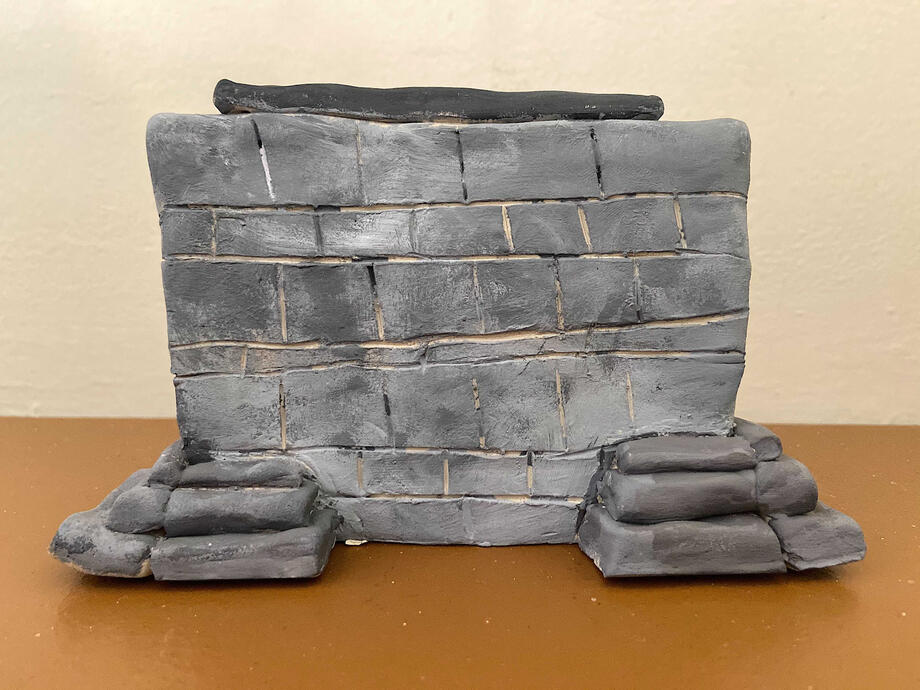
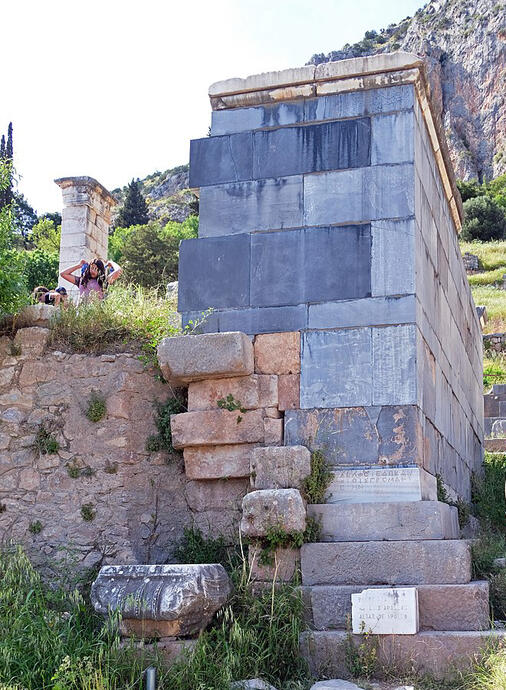
Model of the Altar of the Chians at Delphi in comparison to the actual altar
This is the Altar of Chians, also known as the Temple of Apollo Pythios or the Great Altar. It is part of the Temple of Apollo at Delphi, and it was used for large sacrifices.
The Altar of Chians was built by the people of the island of Chios in the 5th century BCE and restored by them in the 1920s. Because of their patronage, they were allowed to be first in line to consult the Oracle. That sentiment is inscribed onto the stone: ΔΕΛΦΟΙ ΕΔΩΚΑΝ / ΧΙΟΙΣ ΠΡΟΜΑΝΤ / ΕΙΗΝ (Δέλφοι ἔδωκαν Χιοις προμαντεῖην, "The Delphians gave to the Chians the right of first consul to the oracle.")
Not only did the altar allow the Chians to go first, but it also displayed their wealth through the use of black Eleusinian stone. The black stone contrasted the typical white stone and made it stand out.
Purification Rituals
THe Ewer
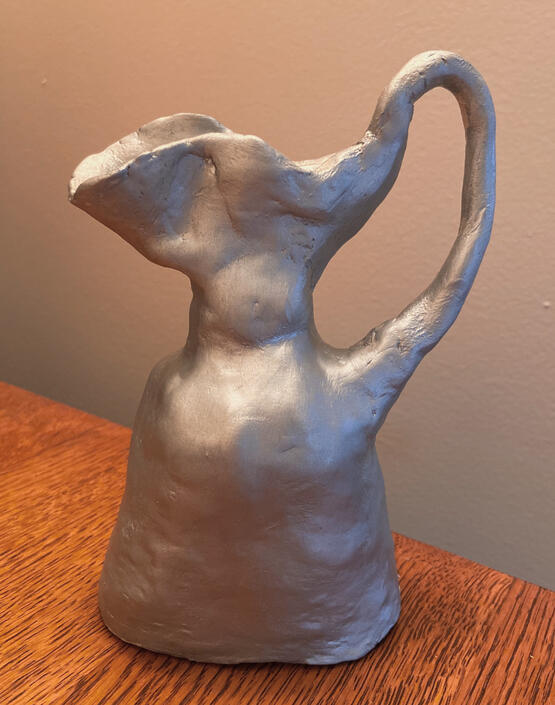
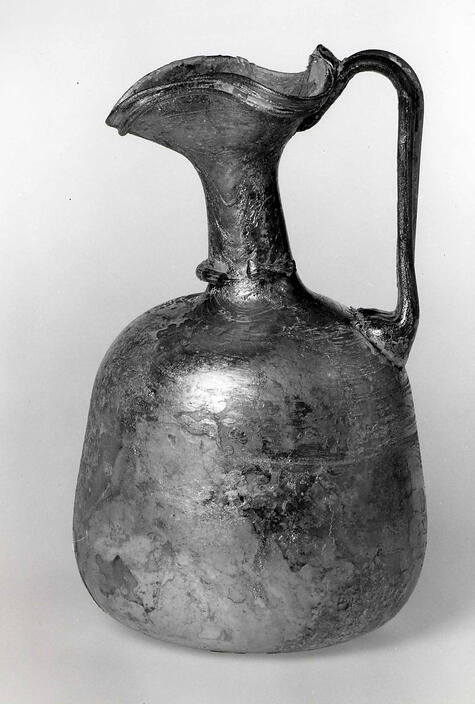
Model of an ewer, in comparison to the 4th century ewer displayed at the met as part of the Robert Lehman collection (1975)
This is an ewer, an instrument frequently used in purification rituals. The model is based on a Roman ewer that was crafted during the 4th century BCE. This particular ewer is made of glass but they could be made from a variety of other materials such as gold, silver, copper, and bronze.
Glassworking was an art form that evolved throughout history. As glass workers explored new techniques and developed a deeper understanding of the materials, glass products increased in quality. Roman glassmakers, known as vitriarii, fused silica, lime, and sodium carbonate together in an extremely hot kiln. This newly created glass could then be shaped using a variety of techniques. Before the popularization of glass blowing in the 1st century BCE, molds were commonly utilized to shape glass.
Ewers were mainly used to hold water and would be used to purify hands and feet in sprinkling rituals. The water could be sourced from a variety of places. Some sanctuaries had their own fountain, while others extracted water from nearby springs or seas. The source of the water was not an important factor in determining the power of the water, instead, the formal act was what gave the water significance. The act of sprinkling the water on the body represents a cleansing of spiritual impurities, otherwise known as pollution. Although water is the most common substance used in purification rituals, other forms of purification existed including fumigation, fire, and blood. Rituals could consist of multiple purification elements. For instance, a log from an altar fire could be doused with water and used to sprinkle individuals and the sanctuary. This act combines the purifying nature of both fire and water to symbolically cleanse people and their surrounding areas.
The ewer was important because, in order to enter temples and properly address the gods, a person had to be as pure as possible. The ewer was set out at the entrance of the sanctuary since purity was a ritual for anyone entering a temple. This cleansing was simply a matter of respecting the gods. People were not looked upon favorably if they weren’t pure. In addition to this frequent practice that involved addressing the gods, purification rituals could also be enacted on an individual basis when a person was struggling with illness, mental or physical, or guilt.
The ewer, as a vessel of purification, relates to the broader values about purity and pollution that were embedded in ancient Greek and Roman religion. Purification was an integral part of the mainstream religion practiced by the state, but it also played a role in certain cults. In the cult of Dionysus, for example, the initiation process involved purity on a large scale where prospective members would partake in a large bath in the sea near Athens.
the kopis
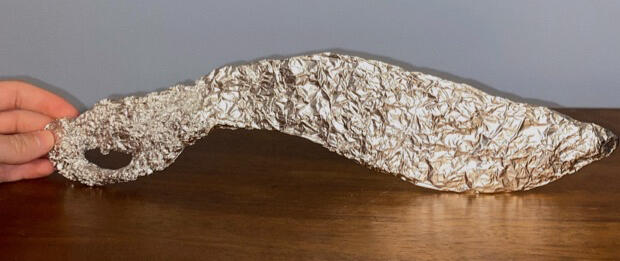
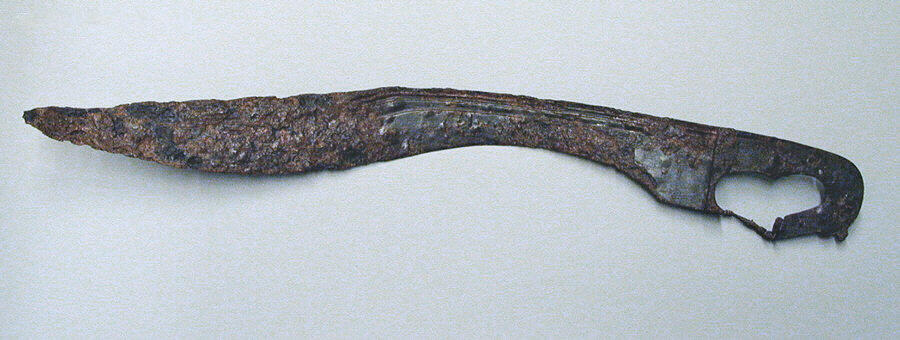
Model of the Kopis beside an actual Greek Kopis from the Metropolitan Museum of modern Art
The kopis was a large knife used to slaughter animals in sacrificial rituals. The model is based on an iron kopis that was crafted between the 4th and 5th century BCE. The knife’s unique shape is often referred to as “recurved.” The way weight is distributed in the curve allows the user to deliver a blow that is both forceful and precise.
The process for crafting a kopis blade can be classified by three stages– forming, heat treating, and finishing. In forming, metal is heated until it can easily be manipulated and shaped. Welders would then be able to shape the iron using hammers and anvils. In heat treating, the blade is heated and cooled slowly to fix any inconsistencies in the weight distribution and overall shape. Sharpening the edge of the blade is the final step in the kopis making process.
The sharp edge of the kopis is used to cut the throats of warm-blooded animals in sacrifices and blood purification rituals. Purification rituals involving blood are commonly used in the cleansing of a murderer. Although blood and purity seem to be contradictory to each other, the Greeks found significance in this ritual. When one causes blood shed, he must be covered in the blood as a reminder of his actions that he will eventually overcome. Since the blood can easily wash away, so can the sins of the murderer. In this ritual, a slaughtered piglet is raised over the head of the murderer, so that the blood may flow over the body. There are also accounts of blood purification being used in the context of war. The Macedonian army took part in a purification ritual where the soldiers marched between two halves of a dog. This act is then followed by a sham battle. The act of walking between the carcass symbolizes a purification for the men before they go off to battle.
In Greek literature, blood sacrifice is present in the story of Orestes, the son of Clytemnestra and Agamemnon. Orestes flees his town after killing his mother. Being pursued by vengeful goddesses (Furies), he seeks refuge in the temple at Delphi. He encounters Apollo, who proceeds to perform a blood purification ritual on him.
fun facts!
The concept of purification is old — it's mentioned in works by Hesiod and Homer.
Valentine's Day actually evolved from a Roman purification festival called Lupercalia. Historians date the inception of this festival to around the 6th century BCE. The blood of sacrificed animals was smeared over the bodies of the festival attendees. The blood was then wiped clean with a piece of wool soaked in milk. This cleansing was symbolic of purity and new life, and was thought to make women more fertile.
Priests, known as katharti, were specialized in the field of purification. Their services were called on especially during times of crisis.
about
Introduction
This project was created and presented for CLAS 59: Ancient Magic and Religion, taught by our incredible professor, Dr. Lye. This class was curated for freshmen, and it allowed us to creating meaningful connections with our peers despite the ongoing pandemic. We were tasked with constructing objects that were used in magical or religious practices. We chose to focus on ancient temples and rituals because we learned early on in the course how significant these structures and rituals were in ancient societies. We wanted to expand our understanding of these elements in both the Greek and Roman context.
Meet Our Group!
Olivia Allred: Presenter, Temple of Apollo
Josie DeLellis: Website Builder, Researcher, The Ewer, Altar of the Chians
Tarleton Hunt: The Pantheon
Hannah Thompson: Writer, Researcher
Elise Trexler: Presenter, Researcher, The Kopis
Media Used

Tarleton used the Murray Makerspace 3D printer to create the Pantheon. It took 16 hours to design and print this object.
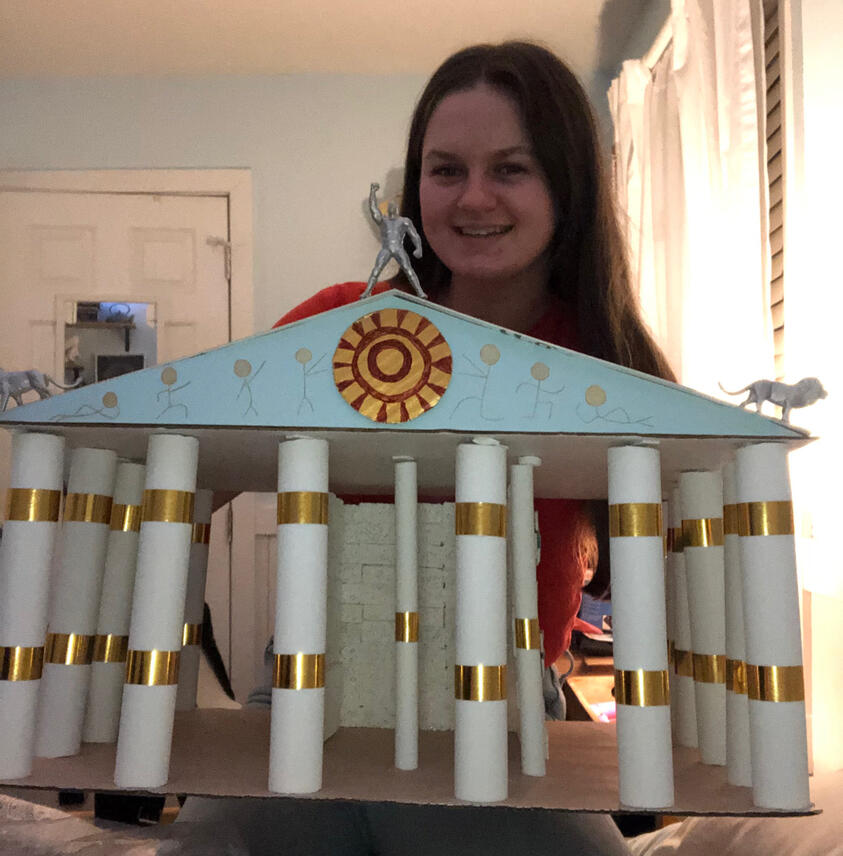
Olivia made the Temple of Apollo at Delphi using foam, poster board, mini figures, and spray paint. The construction process took approximately 4 hours.
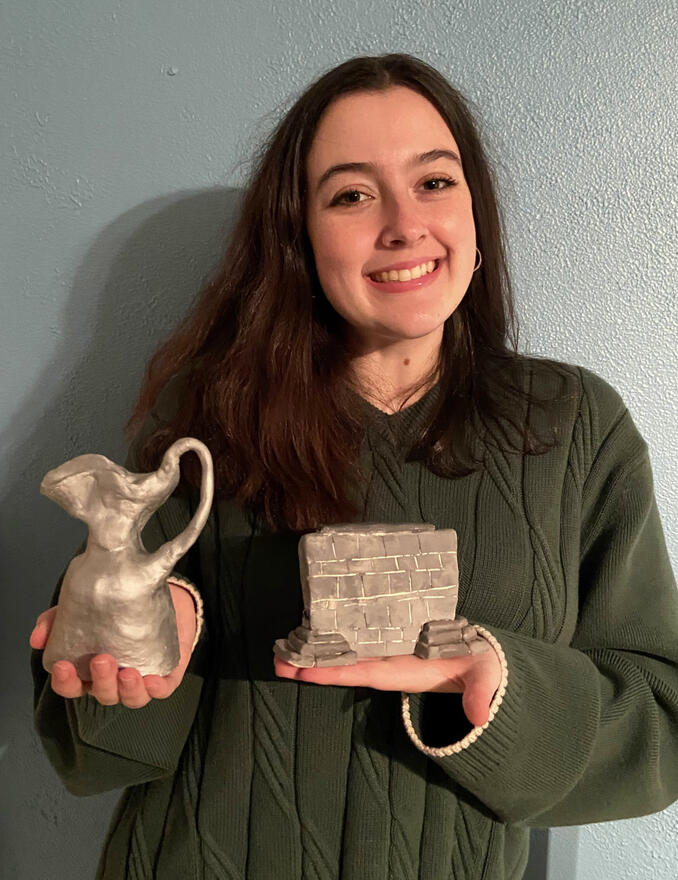
Josie constructed the Ewer and the Altar of the Chians using clay and acrylic paint. In total, 3 hours were spent molding and painting these objects.

Elise crafted the Kopis out of tinfoil. It took her approximately 30 minutes to complete.
references
Auboyer, Jeannine. “Objects Used in Purification Rites.”
Encyclopædia Britannica, Encyclopædia Britannica, Inc., 19 Sept. 1998, www.britannica.com/topic/ceremonial-object/Objects-used-in-purification-rites.
Burkert, Walter. Greek Religion. Harvard University Press, 2006.
Cartwright, Mark. “Delphi.” Ancient History Encyclopedia, Ancient History Encyclopedia, 20 Nov. 2020, www.ancient.eu/delphi/.
Cartwright, Mark. “Pantheon.” Ancient History Encyclopedia, Ancient History Encyclopedia, 17 Nov. 2020, www.ancient.eu/Pantheon/.
Cartwright, Mark. “Roman Glass.” Ancient History Encyclopedia, Ancient History Encyclopedia, 20 Nov. 2020, www.ancient.eu/article/592/roman-glass/.
Comitatus, Comitatvs. “A Short Guide to Greek Short Swords.” Comitatus, www.comitatus.net/greekswords.html.
The Editors of Encyclopaedia Britannica. Orestes. 20 Feb. 2020, www.britannica.com/topic/Orestes-Greek-mythology.
History.com Editors. “Delphi.” History.com, A&E Television Networks, 9 May 2018, www.history.com/topics/ancient-greece/delphi.
History.com Editors. “Lupercalia.” History.com, A&E Television Networks, 13 Dec. 2017, www.history.com/topics/ancient-rome/lupercalia.
History.com Editors. “Pantheon.” History.com, A&E Television Networks, 31 Jan. 2018, www.history.com/topics/ancient-greece/pantheon.
Laurvik. “The Temple of Apollo at Delphi, Greece.” Wikimedia Commons, 28 Dec. 2008, commons.wikimedia.org/wiki/File:TheTempleofApolloatDelphi.jpg.
Mauro, David. “Altar of Apollo.” Wikimedia, 15 May 2018, commons.wikimedia.org/wiki/File:Altarofapollo01.jpg.
Näsström, Brit-Mari. “The Rites in the Mysteries of Dionysus: The Birth of the Drama.” Brewminate, 25 Sept. 2018, brewminate.com/the-rites-in-the-mysteries-of-dionysus-the-birth-of-the-drama/.
Pruitt, Sarah. The Secrets of Ancient Roman Concrete. 21 June 2013, www.history.com/news/the-secrets-of-ancient-roman-concrete.
[unknown], “Altar of the Chians,” Hollins University Library Digital Exhibits, accessed November 22, 2020, https://digitalexhibits.hollins.edu/items/show/43.
User mf613. “The Site: Altar of Chians.” Panhellenic Delphi, 5 Nov. 2014, panhellenicdelphi.wordpress.com/2014/11/05/altar-of-chians/.